01
Frontend
Interfaces that feel fast and don't fall apart. 3D in the browser when it earns its place, not because it's cool. (It is cool.)
- TypeScript
- React 19
- Next.js
- TanStack Start
- Tailwind CSS
- Vite
- Three.js
- GSAP
I know enough to build useful things and I'm curious enough to keep learning. History taught me patience. Tech taught me speed. This site is the evidence file.
// Manifesto
Show me a working app and I'll want to take it apart. Show me a headline about a 200-year-old revolution and I'll want to know the humidity that Tuesday. It's a minor personality disorder. But over four years, it managed to output some highly functioning, shipped code: drone autopilots that handle GPS failure better than I handle small talk, chatbots that remember things I forgot yesterday, and tools that catch fake news right before your uncle hits "send."
Interfaces that feel fast and don't fall apart. 3D in the browser when it earns its place, not because it's cool. (It is cool.)
Models that run where they're needed — on a Raspberry Pi strapped to a drone, or entirely inside your browser tab.
APIs, auth, databases, push notifications, and the boring plumbing that makes the fun parts work.
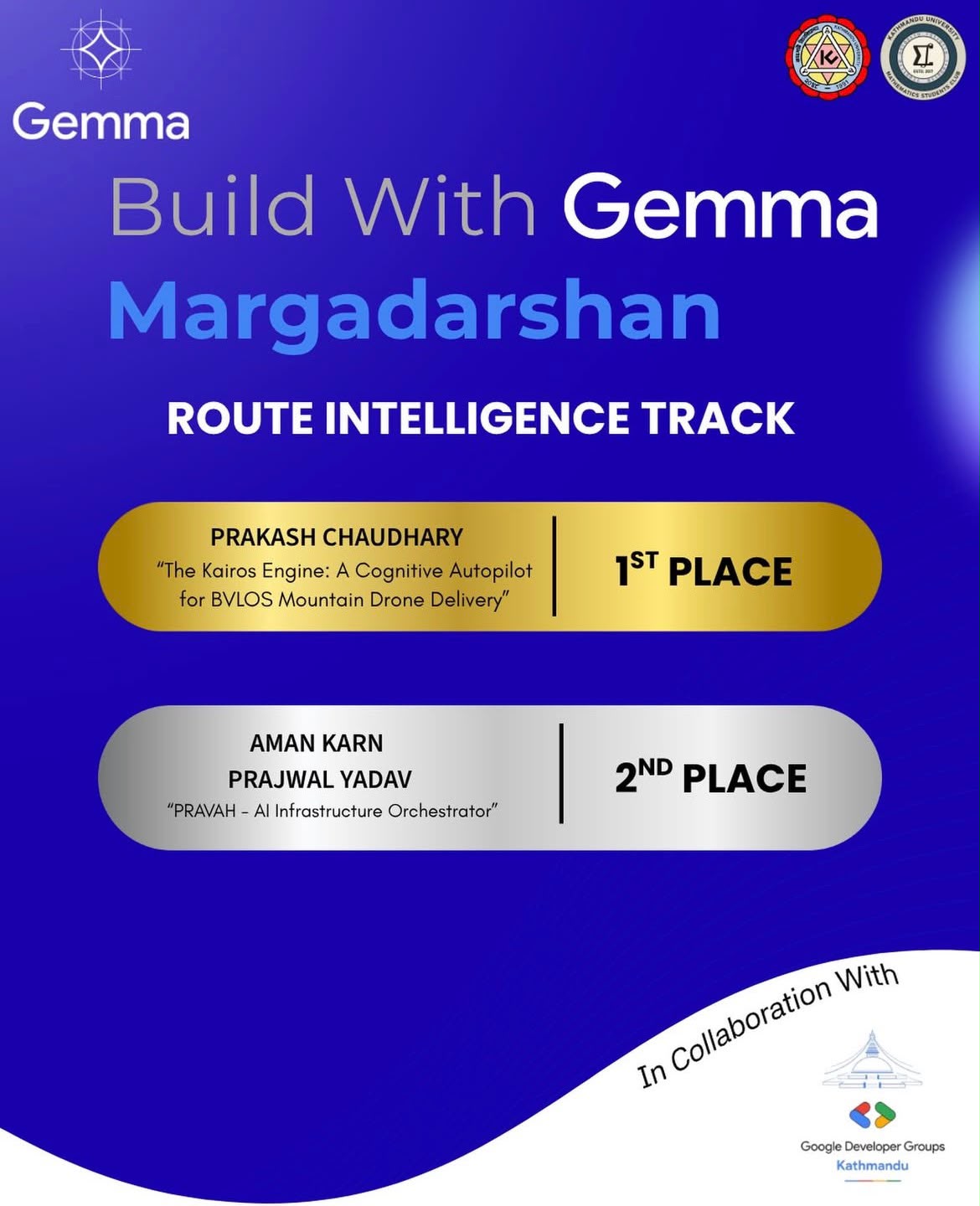
A Cognitive Autopilot for BVLOS Mountain Drone Delivery
Built for Build With Gemma: Margadarshan, winning first place (and $600) in the Gemma for Route Intelligence track. It gives a delivery drone something it has never had: judgment.
First place in the Gemma for Route Intelligence track came with a $600 cheque — the first time a side project paid for itself.
// Problem
Today's delivery drones fly like trains on a track — when wind or battery fails mid-flight, the only fallback is Return-to-Launch. In the Himalayas that move is often fatal, because home may sit behind a 4,000 m ridge the drone cannot clear. The Kairos Engine is not a flight controller; it is a decision-making brain that sits on top of one.
// Evidence 01 of 04 — tap a thumbnail
A live digital twin for hydropower river forecasting
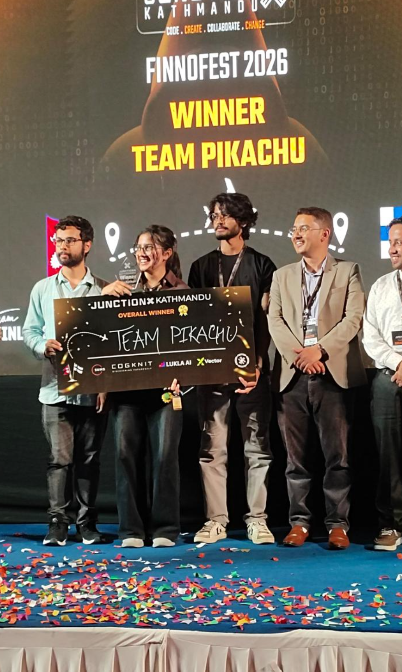
Built for the JunctionX Kathmandu Hackathon. We won the track and the overall competition — and with it, the ticket to represent Nepal at Junction in Helsinki, Finland this November.
Winning JunctionX Kathmandu earned us a ticket to Junction in Helsinki this November — Team Pikachu goes international.
// Problem
Hydropower plants currently rely on manual measurements and decades-old data, leading to costly grid penalties.
// Evidence 01 of 04 — tap a thumbnail
I stare at the problem and ask "wait, can this even be done?" Usually the answer is yes, with caveats.
Papers, docs, other people's code, and — occasionally — a history book that has nothing to do with it.
Build the ugliest version that works. Then break it on purpose. Then fix it. Repeat until it stops breaking.
If I can't write it up clearly, I didn't understand it. Every project ends with a writeup or a demo.
// Then back to step 01. Always.